The Foundation of a Winning Presentation
A presentation is more than a collection of slides; it is a strategic communication tool. When you stand in front of an audience, your goal is to move them from their current mindset to a new understanding or action. This journey requires a logical path. Without a clear framework, audiences quickly become overwhelmed, confused, and disengaged.
Research indicates that audiences retain structured information much more accurately than disorganized data. A well-planned sequence helps reduce cognitive load, allowing listeners to focus on your core message. Furthermore, a solid framework builds your credibility as a speaker. When you know exactly where your narrative is heading, you present with greater confidence and authority.
Why Flow Matters
Flow refers to the seamless transition from one idea to the next. It ensures that your audience never has to guess how a piece of evidence relates to your main point. Good flow acts as an invisible thread tying your introduction, supporting arguments, and conclusion together.
To achieve this, you need to understand your audience deeply. What do they already know? What are their pain points? By answering these questions, you can tailor your content to match their expectations and guide them naturally toward your desired outcome.
Essential Components of Every Talk
Regardless of the specific format you choose, almost every successful talk relies on three foundational pillars: the introduction, the body, and the conclusion.
The Introduction: Hooking Your Audience
Your opening sets the tone for everything that follows. You have only a few moments to capture attention and prove that your talk is worth listening to.
- The Hook: Start with a surprising statistic, a thought-provoking question, or a short, relatable story.
- The Promise: Clearly state what the audience will learn or gain by listening to you.
- The Roadmap: Provide a brief agenda. Let them know the main points you will cover. This reduces anxiety and sets clear expectations.
The Body: Delivering the Value
The body is where you deliver on the promise made in your introduction. It contains your main arguments, supporting evidence, and key takeaways.
- Rule of Three: Group your main points into threes. The human brain processes and remembers information best in groups of three.
- Supporting Evidence: Back up your claims with data, case studies, or expert quotes from [High-Authority Industry Journals].
- Smooth Transitions: Use transitional phrases like “Building on that idea,” or “This leads us to the next challenge,” to connect your points.
The Conclusion: Driving Action
Never end abruptly. Your conclusion should summarize the journey and tell the audience exactly what to do next.
- The Summary: Briefly recap your main points. Do not introduce new information here.
- The Call to Action (CTA):: Tell them exactly what you want them to do. Whether it is signing up for a trial, adopting a new mindset, or approving a budget, make it clear and direct.
- The Final Thought: Leave them with a powerful closing statement or quote that reinforces your core message.
A strong foundation built on a clear introduction, structured body, and purposeful conclusion ensures your audience stays engaged from start to finish.
Top Formats for Maximum Impact
Different goals require different approaches. Here are the most effective formats you can use to structure your next talk.
1. The Problem-Solution Framework
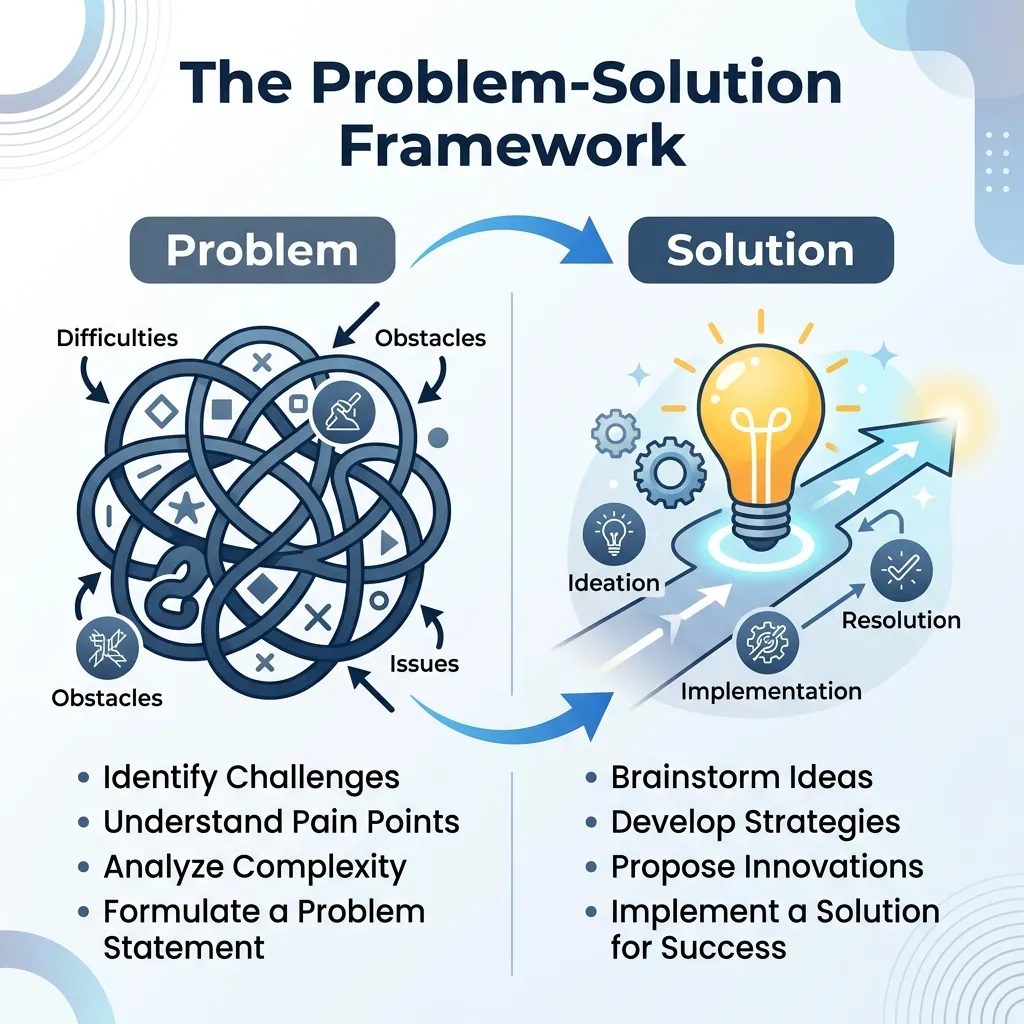
This format is perfect for persuasive pitches and sales presentations. It leverages the audience’s desire to resolve a specific pain point.
- The Problem: Clearly define the issue your audience is facing. Make it urgent and relatable.
- The Agitation: Explain the negative consequences of leaving the problem unsolved.
- The Solution: Introduce your product, service, or idea as the ideal fix.
- The Proof: Provide evidence that your solution works.
2. The Storytelling Approach (Hero’s Journey)

Humans are wired for stories. Using a narrative arc keeps listeners emotionally invested.
- The Status Quo: Describe the ordinary world.
- The Challenge: Introduce a conflict or hurdle.
- The Climax: Share the struggle and the turning point.
- The Resolution: Reveal the lesson learned or the positive outcome.
3. The SCQA Method
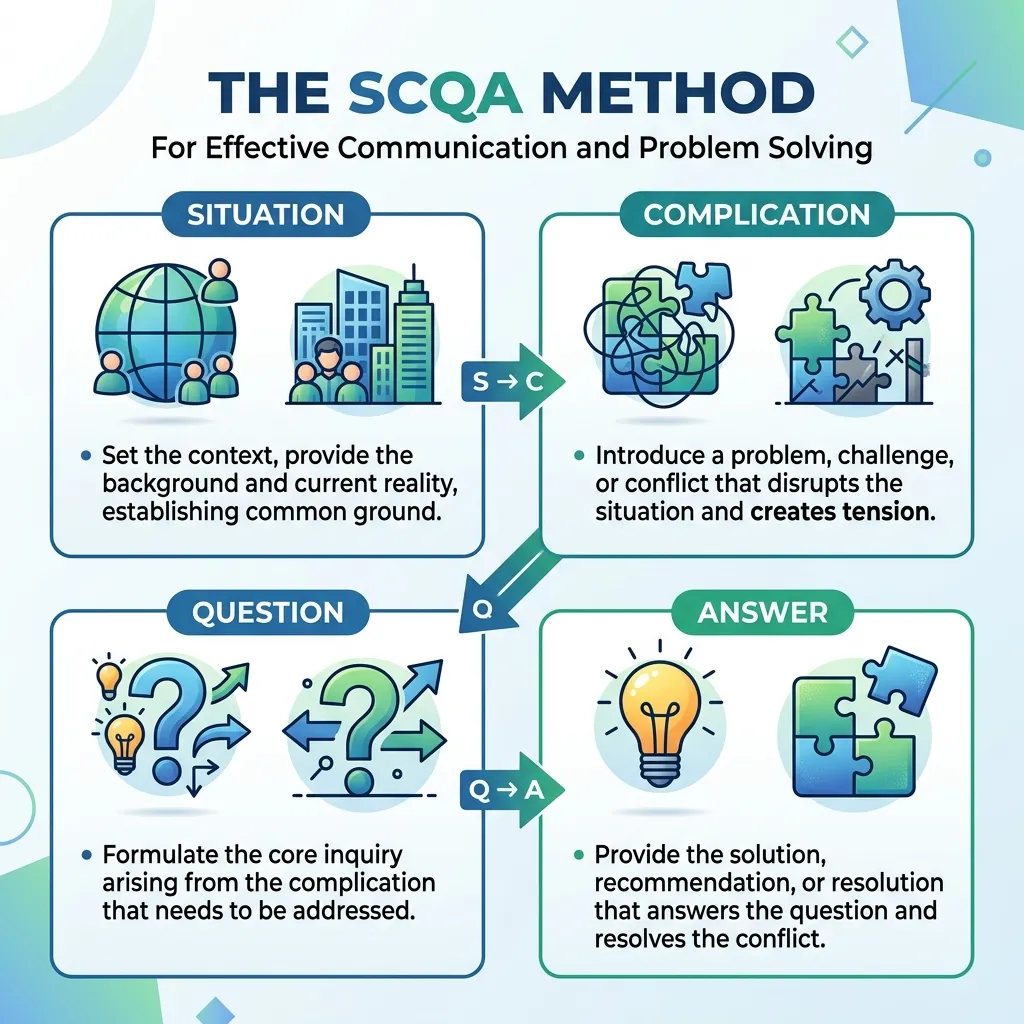
Popularised by management consultants, this method is highly effective for executive briefings and analytical reports.
- Situation: State the current, undisputed facts.
- Complication: Introduce the trigger or change that disrupts the situation.
- Question: Pose the core problem that needs solving.
- Answer: Present your strategic recommendation.
4. The What, So What, Now What Flow
This is an incredibly simple yet powerful way to organize informational updates or team meetings.
- What: Present the facts, data, or updates.
- So What: Explain why this information matters to the audience.
- Now What: Outline the next steps or required actions.
Format Comparison Table
|
Format |
Best Used For |
Key Strength |
|---|---|---|
|
Problem-Solution |
Sales, Persuasion |
Creates urgency and demonstrates direct value. |
|
Storytelling |
Keynotes, Inspiration |
Builds deep emotional connections. |
|
SCQA |
Executive Briefings |
Highly logical and cuts straight to the strategic core. |
|
What, So What, Now What |
Status Updates |
Keeps information highly relevant and action-oriented. |
Selecting the right format depends entirely on your specific objective and your audience’s mindset. Match the framework to your goal for maximum resonance.
Advanced Techniques for Seamless Delivery
Once you have your framework, you need to polish the delivery. How you present the information is just as important as the information itself.
Strategic Internal Linking and Cross-Referencing
If you are delivering a series of talks or a complex training module, use internal references to build continuity. Refer back to earlier points or hint at what is coming next. This acts like an [Internal Knowledge Cluster], helping the audience connect the dots across different sections of your material.
Managing Cognitive Load
Do not overwhelm your listeners.
- Use the “One Idea Per Slide” rule.
- Rely on visuals rather than dense bullet points.
- Provide regular mini-summaries to help them consolidate what they just learned.
Interactive Elements
Break up long monologues by inviting the audience into the conversation.
- Ask rhetorical questions.
- Run live polls.
- Encourage brief discussions with the person sitting next to them.
Expert Insights and Common Mistakes
Even seasoned speakers fall into predictable traps. Avoid these pitfalls to elevate your performance.
Common Mistakes to Avoid
- The Data Dump: Throwing too many statistics at the audience without context. Always explain what the data means.
- Burying the Lead: Waiting until the very end to state your main point. Tell them early on why they should care.
- Weak Transitions: Jumping abruptly between topics. This confuses listeners and breaks the flow.
Pro Tips for Success
- Start Analog: Outline your presentation structure on paper or a whiteboard before opening any software. This forces you to focus on the narrative rather than the design.
- The 10-20-30 Rule: Popularized by venture capitalists, this rule suggests using no more than 10 slides, speaking for no more than 20 minutes, and using a font size of at least 30 points.
- Practice with Distractions: Rehearse in a noisy room or while doing a mundane task. This builds resilience and ensures you know your material inside and out.
Mastering your presentation structure transforms average talks into unforgettable experiences. Start applying these frameworks today to build confidence and captivate your listeners. Ready to elevate your speaking skills? Share this guide with your team and begin crafting your next winning presentation now!
FAQs
1. What is the best way to start a presentation?
Start with a compelling hook. This could be a surprising statistic, a relatable short story, or a thought-provoking question that immediately grabs the audience’s attention and introduces the core theme.
2. How long should an introduction be?
An introduction should typically take up 10% to 15% of your total speaking time. It needs to be long enough to establish context and build rapport, but short enough to get to the main value quickly.
3. What is the SCQA framework?
SCQA stands for Situation, Complication, Question, and Answer. It is a highly logical framework used primarily in business and consulting to structure complex problems and deliver clear, strategic recommendations.
4. How many main points should I include?
Aim for three main points. The human brain easily processes and remembers information presented in threes. If you have more than three points, try grouping them into three broader categories.
5. How do I transition smoothly between slides?
Use verbal bridges that link the concluding thought of one slide to the opening thought of the next. Phrases like “This challenge leads us directly to…” or “Now that we understand the problem, let’s look at the data” work well.
6. Should I put my conclusion at the beginning?
In some executive or highly analytical settings, it is best to use the “Bottom Line Up Front” (BLUF) approach. State your conclusion or main recommendation first, then use the rest of the time to prove your case.
7. How do I avoid overwhelming my audience with data?
Apply the “So What?” test to every data point. If the statistic does not directly support your main argument or drive action, remove it. Use clean charts and focus on the meaning behind the numbers.
8. What is the Hero’s Journey in public speaking?
It is a storytelling framework where you describe a character (often the customer or yourself) who faces a challenge, struggles, learns a lesson, and ultimately overcomes the obstacle to achieve a better state.
9. How do I handle Q&A sessions effectively?
Prepare for potential objections in advance. Listen carefully to the entire question before answering. If you do not know the answer, admit it honestly and offer to follow up after the event.
10. What makes a Call to Action (CTA) effective?
An effective CTA is specific, actionable, and time-bound. Instead of saying “Think about this,” say “Sign up for the software trial by Friday to see these results for yourself.”